

Your AI SOC Can Be Right and Still Be Untrustworthy
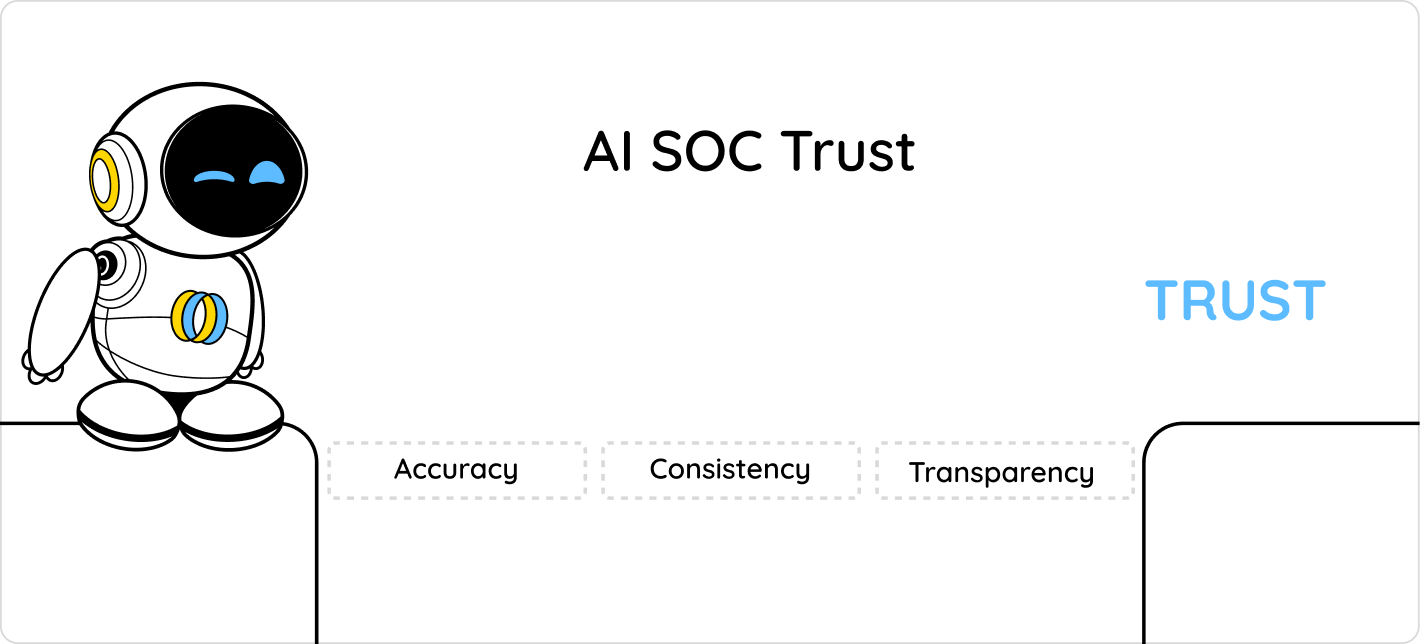
In security operations, trust is not earned by accuracy alone.
It is tempting to think that if an AI system gets the right answer often enough, analysts will naturally trust it. But anyone who has worked in a SOC knows that security decisions are not judged only by whether the final answer appears correct. Analysts need to understand whether a decision is reliable, reproducible, explainable, and defensible.
At Embed, we think about trust differently.
We’ve seen this pattern repeatedly: an ML-based detection starts firing and, over time, demonstrates that it’s reasonably accurate. It catches legitimate threats. It surfaces interesting activity.
And yet, we still don’t fully trust it.
Every alert requires a deep dive. Every decision requires validation. Not because the detection has been wrong, but because the analyst doesn’t understand why it was right. What signals did it key on? Which evidence mattered most? Under what conditions might it fail?
The detection may have earned confidence, but it hasn’t earned trust. That distinction matters.
Accuracy + Consistency + Transparency = Trust
These are the three pillars we believe an AI SOC product must be built on. Accuracy matters deeply, but accuracy by itself is not enough. A system can be right and still be difficult to trust. A system can produce a correct conclusion but fail to show the evidence behind it. A system can perform well in a demo but behave unpredictably in production.
Trust is not a byproduct of accuracy. For AI to be useful in security operations, trust has to be engineered into the product. Trust is not something a vendor can declare. It is something security teams must be able to verify for themselves.
Accuracy
Does It Get the Right Answer?
Accuracy is the correctness of the outcome.
Did the system identify the real threat? Did it understand the alert? Did it incorporate the right context? Did it distinguish between malicious activity, benign behavior, and noise? Did it make the right recommendation?
Accuracy is foundational. But in security, accuracy cannot be treated as a single model score or a marketing claim. It has to be designed, measured, tested, and continuously improved.
That requires:
- Ground truth datasets and evaluations
- Continuous testing and regression checks
- Automated learning from analyst feedback
- Structured investigations that produce comparable outputs over time
Accuracy is not a feature. It is a system property.
It comes from:
- The way evidence is collected
- How investigations are structured
- How models are evaluated
- How analyst feedback is incorporated
- How the product improves as the environment changes
Consistency
Does It Produce the Same Analysis with the Same Evidence?
Security operations require reproducible decisions.
LLMs are naturally non-deterministic. They may phrase things differently, weigh context differently, or take different paths to an answer. But SOC systems cannot behave like creative writing tools. Analysts need dependable behavior, especially when decisions affect escalation, triage, containment, and response.
Consistency means the system follows thoughtful investigation steps. It gathers evidence predictably. It applies stable decision logic. It maintains a clear mapping from evidence to conclusion.
In practice, that means:
- Investigations should follow repeatable steps
- Evidence gathering should be predictable
- Decision logic should be stable
- Similar evidence should produce similar outcomes
Security decisions must be reproducible because they must be defensible.
An analyst should not have to wonder whether the system reached a conclusion because of actual evidence or because the model happened to take a different path this time.
Transparency
Can Analysts Review How the Decision Was Made?
Transparency is visibility for analysts.
A security decision must be explainable, auditable, and reviewable. It is not enough for an AI system to say, “This is suspicious.” Analysts need to see why, and security leaders need confidence that the reasoning can be validated, challenged, and defended.
That means every conclusion should be supported by evidence. Investigation steps should be visible. Reasoning should be understandable. Decisions should be something an analyst can verify, challenge, or approve.
Transparency requires:
- Evidence supporting every conclusion
- Visible investigation steps
- Clear reasoning behind outcomes
- Decisions analysts can independently verify
AI and ML systems need to show their work.
But this is more than asking an LLM to summarize what it did. Security analysts need access to the real evidence: the logs, endpoint activity, network context, identity signals, email artifacts, process trees, timelines, and other supporting details.
That makes transparency an engineering problem.
How is evidence collected? How is it stored? How is it surfaced? How long is it retained? How does an analyst move from a conclusion back to the underlying facts? How does the system make its reasoning reviewable without overwhelming the user?
These are product and infrastructure decisions, not prompt engineering tricks.
Trust Has to Be Built Into the System
At Embed, these principles shape how we build.
We believe AI in the SOC should not ask analysts to trust conclusions they cannot independently verify. It should be an investigative system that helps analysts move faster while preserving the standards security teams depend on: correctness, reliability, and auditability.
That is why trust has to be more than accuracy.
Accuracy answers: Did it get the right answer?
Consistency answers: Would it reach the same conclusion again with the same evidence?
Transparency answers: Can an analyst understand and verify how it got there?
Only when all three are present can an AI SOC product earn real trust.
Security teams do not need magic. They need systems they can rely on during real investigations.
That is what we are building at Embed.