
Build vs. Buy AI for the SOC? You're Probably Asking the Wrong Question

Many security leaders evaluating AI SOC products eventually ask:
Should we build an AI SOC analyst ourselves, or should we buy one?
It’s a reasonable question.
If you have a mature engineering organization, experienced AI engineers, unique security workflows, and the flexibility to maintain long-term, building internally may be the right investment.
Today, a small team can connect an LLM to security data and produce an impressive investigation demo in days instead of months.
But after spending the last several years building AI for security operations, we believe that build versus buy isn’t the first question an organization should ask.
The better question is: Are we prepared to own everything that comes after that first successful prototype?
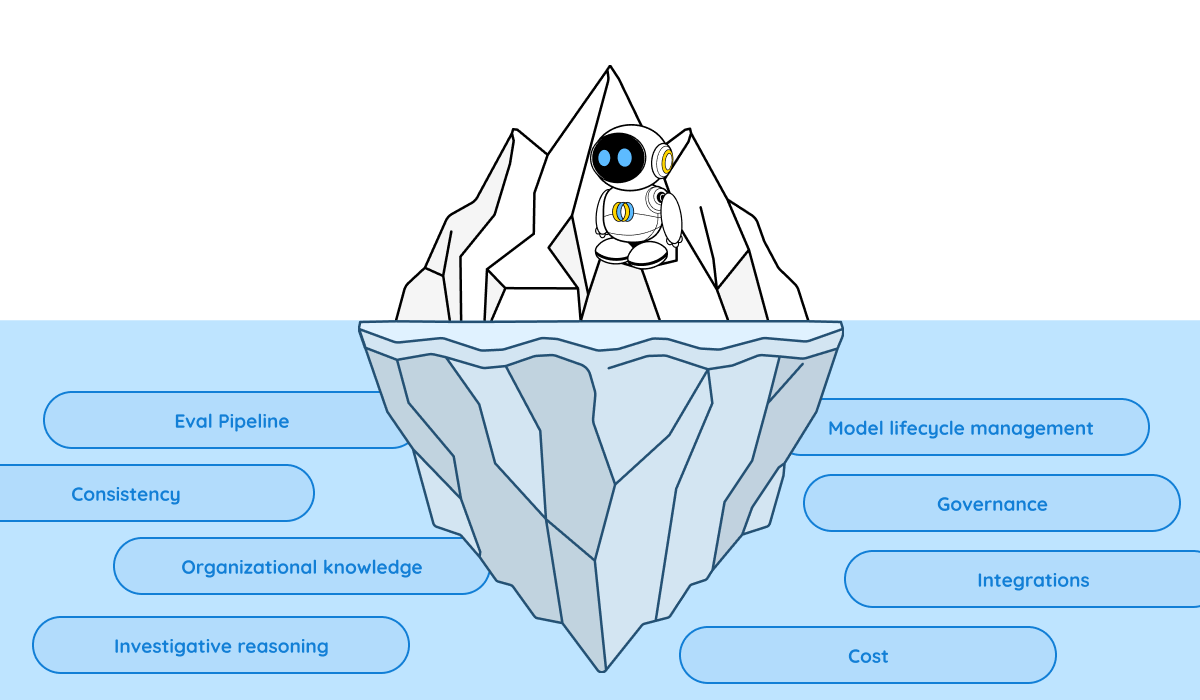
The First Prototype is Easier Than Ever
Nearly every team follows a similar journey.
It usually starts with a single prompt.
Feed an alert into an LLM. Ask it to investigate. Ask for a recommendation. Maybe add a few pieces of context.
The results are often impressive.
The model identifies suspicious behaviors. It explains what it found. It produces a polished investigation summary that looks remarkably close to something a security analyst might write.
For many teams, this is the moment AI begins to feel inevitable. The technology is genuinely remarkable.
Unfortunately, this is also where it’s easy to underestimate what comes next.
An Answer isn’t the Same as a Trusted Investigation
A good-looking answer is not the same thing as an investigation your security team is willing to trust.
Very quickly, you’ll notice things that need improvement.
The model misses important organizational context. Similar alerts receive different conclusions. Certain prompt changes improve one scenario while making another worse. Large investigations exceed context limits. Occasionally, the model confidently reaches the wrong conclusion.
None of these are surprising. They’re simply reminders that a prompt is not an investigative system. So you improve it:
- You add enrichment steps.
- You split responsibilities across multiple prompts.
- Eventually you introduce specialized agents responsible for triage, evidence gathering, summarization, or response.
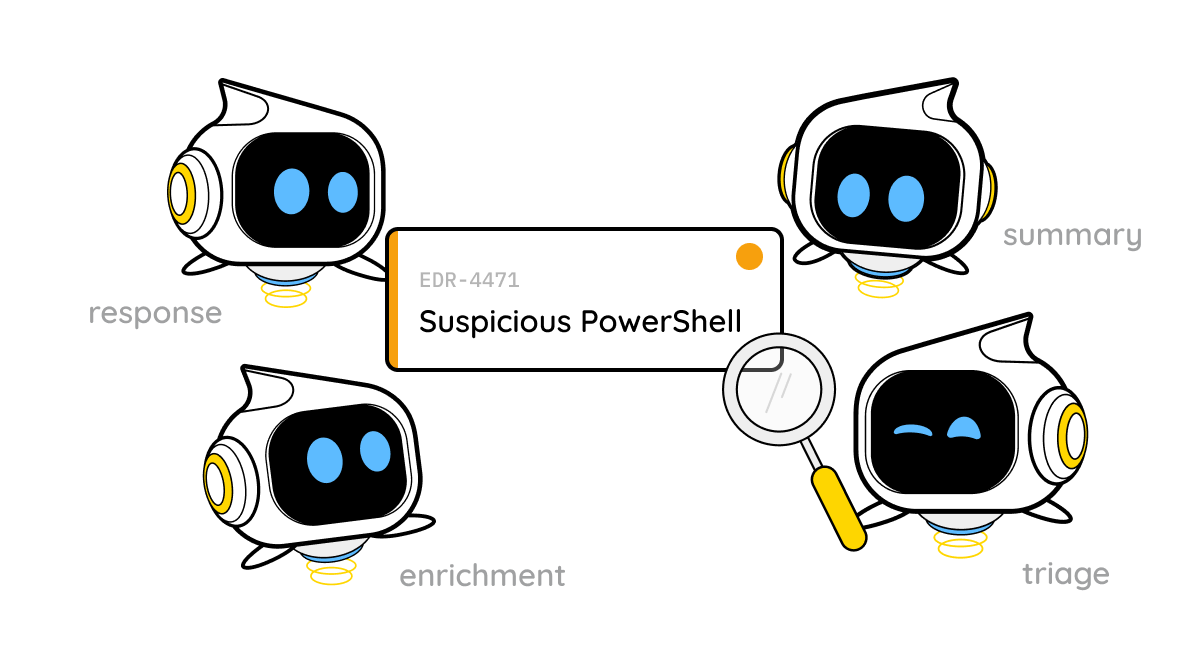
The prompt is evolving into a system that has become significantly more complex.
You’re now building, operating and debugging an AI system.
Now new questions begin to emerge:
- Why did this investigation take this path?
- Why did the agent skip an important piece of evidence?
- Why did the same alert produce a different answer this week than it did last week?
- How do we know this new model version actually improved anything?
The Real Work Starts After the Demo
This is the part of AI SOC development that rarely gets discussed.
Getting a convincing demonstration working is no longer the difficult part. LLMs have most definitely made that accessible to everyone. Building something that analysts trust every day is. That requires solving a collection of engineering problems that continue long after version one ships.
Evaluation
Every change, whether it’s a prompt, an agent, a retrieval strategy, or a new model – changes system behavior.
How do you know v5 is better than v4?
This requires evaluation pipelines, expert-reviewed datasets, regression testing, and continuous measurement. Without that rigor, improvements become guesswork.
Consistency
Security teams don’t just need accurate answers, they need predictable ones. The system needs to behave consistently across alert types, customers, time, and model updates. This allows teams to operationalize AI instead of being skeptical about every investigation.
Organizational Knowledge
Sometimes referred to as tribal knowledge. This is what analysts learn about their company, business and coworkers that enables them to quickly and accurately make ambiguous decisions. Things like VIP users, acceptable administrative tools, expected behaviors, acceptable business practices.
This is accumulated over years and is knowledge that walks out the door every time you lose an analyst.
How to represent this knowledge in an AI system and use it reliably during an investigation is a hard problem. One that is much harder than simply spinning up a vector database.
- How should knowledge be shared across investigations?
- How do you learn over time?
- How long does knowledge live?
- Where does it live and how do you recall it?
Investigative Reasoning
Investigations aren’t linear. This is what makes using a “playbook” as an investigation tool nearly impossible. Analysts gather evidence, form hypotheses, discard them, revisit earlier conclusions, and adapt their approach based on what they discover.
Building AI that reasons through investigations in a similarly adaptive way is fundamentally different from generating a single response to a prompt.
- Are investigations following thoughtful steps?
- Is there stable decision logic?
- Does it include predictable evidence gathering?
- Does the evidence map to decisions?
Model Lifecycle Management
Foundation models continue to evolve rapidly.
Every new model offers opportunities for better performance, but also introduces the possibility of unexpected behavior changes.
- How do you detect regressions?
- How do you migrate safely?
- How do you understand which parts of the system changed and why?
This creates more ongoing operational responsibilities.
Governance
Security teams are accountable for their decisions. AI systems must be equally accountable.
How will you explain to your boss why a True Positive was auto-closed?
Analysts need to understand why conclusions were reached, what evidence supports them, and how those conclusions can be audited later. Asking the model “why” it came up with its answer is not transparent. Transparency is deeper and embedded in how evidence is collected and applied.
Without transparency, trust becomes difficult to earn.
Integrations
An AI SOC Analyst is only as effective as the system it can access.
Security investigations depend on alerts, telemetry, enrichment services, ticketing platforms, identity providers, and response tools. Every integration must be maintained as APIs evolve, authentication changes, vendors introduce new versions, and rate limits or outages occur.
Maintaining this access is an ongoing engineering effort that becomes part of operating the platform.
Cost
Finally, there’s the problem that nearly everyone underestimates.
Running a handful of AI investigations is inexpensive.
Running thousands or millions every month while maintaining quality, responsiveness, and predictable costs becomes an engineering discipline of its own.
Optimizing cost without sacrificing investigation quality quickly becomes part of the product itself.
None of This Means You Shouldn’t Build
None of these challenges are arguments that you can’t build your own AI SOC capabilities.
Most companies don’t build their own datacenters. Hyperscalers do, because infrastructure is central to their competitive advantage and they have the scale to justify the investment. For everyone else, buying infrastructure or space in a datacenter is usually the better decision. Building an AI SOC platform can be similar.
For some organizations, building remains the right strategic decision, where you’re prepared, staffed, and funded to invest for years.
The first prototype is only the beginning.
The long-term investment isn’t prompts.
- It’s evaluation.
- It’s operational discipline.
- It’s governance.
- It’s learning.
- It’s continuously improving a system while maintaining the confidence of the analysts who depend on it.
If You’re Buying, Start Here
Whether you decide to build or buy, the same underlying challenges exist. The difference is that when you’re buying, you’re evaluating whether someone else has already solved them well.
As you evaluate AI SOC platforms, look beyond the quality of the demo. Instead, ask whether the platform demonstrates maturity in the areas that determine long-term success.
Evaluation – How does the vendor measure accuracy, detect regressions, and prove the system is improving over time?
Consistency – Will the platform produce predictable results across customers, analysts, model updates, and new threats?
Transparency – Can analysts understand why the AI reached a conclusion, or are they simply asked to trust the answer?
Context & Learning – How does the system capture organizational knowledge and become more effective as it learns your environment?
Cost Efficiency – Can the platform operate at your scale while maintaining both quality and predictable costs?
These aren’t the only questions worth asking, but they’re a good place to start. In my next post, I’ll dive into more questions every security leader should ask before selecting an AI SOC platform.